


Contents
This tutorial is based on geometry concepts. We will study the types and properties of five quadrilaterals: Parallelogram, rectangle, square, rhombus and trapezium.
Basic definition
In Euclidean plane geometry, a quadrilateral is basically a four sided polygon, with the internal angles adding up to 360°.

Quadrilateral
GMAT Exam Quadrilaterals tutorials are of five types based on their shapes. These are:

We’ll study each of these quadrilaterals in detail.
Also Check GMAT / GRE Mathematics Tutorial Distance. Time and Speed
A parallelogram is a quadrilateral with opposite sides parallel (as seen in the figure below).

If the length of a parallelogram is ‘l’, breadth is ‘b’ and height is ‘h’ then:

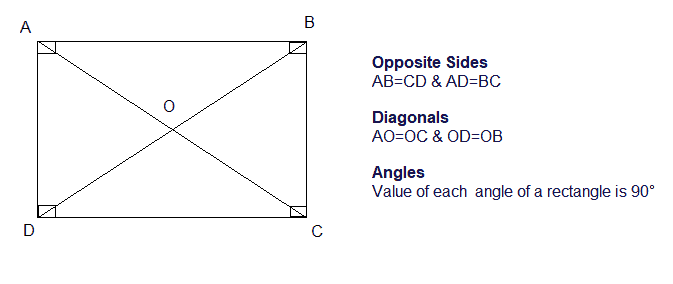
A rectangle is a quadrilateral with all angles at right angles (360°/4 = 90°). (As seen in the figure below)

Properties of a Rectangle
Important formulas
Length of the diagonal = √ (L2 + B2)
 A square is a quadrilateral in which all the sides are equal (as seen in the figure above).
Properties of a square
Also Check GMAT / GRE Tutorial Series Probability
Important formulas for Squares


A rhombus is a quadrilateral having equal sides and opposite sides are parallel to each other. (As seen in the figure above)
Properties of a Rhombus
Important formulas for a Rhombus
If a and b are the lengths of the diagonals of a rhombus,

A trapezium or a trapezoid is a quadrilateral that has only one pair of parallel sides called bases and two lateral sides called legs.
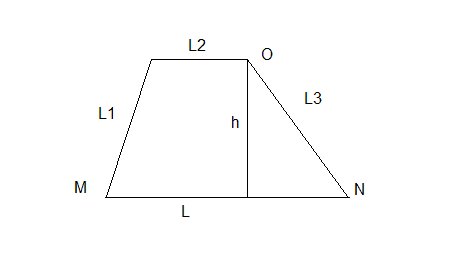
Properties of a Trapezium
Important Formulas for a Trapezium
Also Check GMAT / GRE Tutorial Series Accounting
Summarizing what we have learned so far for quick reference and recollection:
| S.No. | Property | Parallelogram | Rectangle | Rhombus | Square |
|---|---|---|---|---|---|
| 1 | All sides are congruent | ✕ | ✕ | ✓ | ✓ |
| 2 | Opposite sides are parallel and congruent | ✓ | ✓ | ✓ | ✓ |
| 3 | All angles are congruent | ✕ | ✓ | ✕ | ✓ |
| 4 | Opposite angles are congruent | ✓ | ✓ | ✓ | ✓ |
| 5 | Diagonals are congruent | ✕ | ✓ | ✕ | ✓ |
| 6 | Diagonals are perpendicular | ✕ | ✕ | ✓ | ✓ |
| 7 | Diagonals bisect each other | ✓ | ✓ | ✓ | ✓ |
| 8 | Adjacent angles are supplementary | ✓ | ✓ | ✓ | ✓ |
Also read: